

How many cows does Greece actually have?
The question sounds simple. In reality, however, it is turning into one of the most explosive questions of the Greek agricultural subsidy system.
An analysis by POLITICO of Greek government data identifies a striking discrepancy: the numbers of animals linked to European subsidies do not appear to align easily with the actual trajectory of Greek livestock numbers.
And the problem is not limited to a few hundred animals.
We are talking about tens of thousands of cattle and, in the case of sheep and goats, a gap reaching millions of animals between different state databases and statistical measurements.
Discrepancies on their own do not prove fraud. Different databases may utilize different methodologies, reference dates, and recording criteria.
They do prove something else, however, equally serious:
that a state distributing hundreds of millions of euros in agricultural subsidies cannot seem to answer with absolute certainty the most fundamental question, how many animals actually exist.
And following the OPEKEPE scandal, this is not merely a statistical problem.
It is a political bombshell.

260,000 suckler cows - and an account that does not add up
According to data from the Ministry of Rural Development and Food cited by POLITICO, European subsidies were paid in 2024 for approximately 260,000 suckler cows.
Here is where the paradox begins.
A suckler cow typically gives birth to roughly one calf per year. Theoretically, therefore, such a large population of subsidized cows should produce a correspondingly large number of new animals within the national herd.
In that same year, approximately 70,000 cattle slaughters were recorded.
There are, of course, other losses: age, diseases, reduced productivity, deaths, or mandatory culls.
Livestock farmers who spoke to POLITICO estimated these annual losses at approximately 20% of the herd.
Even if this fairly high assumption is accepted, the math leads to a peculiar result: with approximately 260,000 new births and expected culls, the Greek herd should be showing a significant increase.
The exact opposite occurred.
The herd that disappears instead of growing
Official data from the Hellenic Statistical Authority (ELSTAT) show a clear downward trend.
In 2024, 595,153 cattle were recorded in Greece. In 2025, 519,167 remained.
This represents a drop of 12.8% in just a single year. Concurrently, cattle holdings decreased from 9,499 to 7,898.
In other words, while data linked to subsidies project the image of a very large breeding population, data from the official statistical authority show that the total herd is not only failing to grow, but is shrinking at a striking pace.
Somewhere between births, slaughters, declarations, registries, and payments, there is a large void.
And this void is precisely what auditors are beginning to examine.
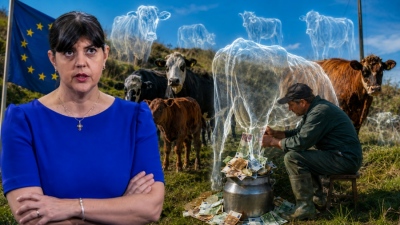
«Schrödinger's cows»: they exist when the subsidy is paid, but where are they in the census?
The picture almost resembles the well-known Schrödinger paradox.
The cows appear to exist simultaneously in two different realities: in one, they exist as numbers that justify subsidies, and in the other, the country's total livestock capital is shrinking.
This does not automatically mean that these specific cows were «imaginary».
It means, however, that without a unified, reliable, and continuously updated registry, the state struggles to prove that every animal for which European funds were paid corresponds to a real animal, on a real farm, and in real livestock farming activity.
And when the subsidy is calculated on the basis of numbers, the quality of the number essentially becomes the quality of the audit itself.
And then come the sheep and goats: here the numbers become even more explosive
If the cattle issue is striking, the picture regarding sheep and goats is even harder to explain.
ELSTAT recorded for 2025 approximately 6.44 million sheep and 2.34 million goats, a total of roughly 8.78 million sheep and goats.
At the same time, the ministry's official veterinary database shows more than 15.5 million sheep and goats registered by regional unit.
The difference approaches 6.8 million animals.
It is a number so large that it cannot simply be dismissed as a minor statistical deviation.
Of course, the two recordings are not necessarily directly comparable: they may have different reference periods, different update procedures, and different purposes.
Yet that is precisely the problem.
How can a European payment system function reliably when two official state sources can produce such vastly different pictures for the very same livestock population?
The state has numbers - but does not have a single number
Nikos Dimopoulos, president of the Kavala Livestock Breeders Association, described to POLITICO the core of the problem: without an actual nationwide census, there is no reliable picture of how many animals exist in the country.
This is perhaps more important even than the suspicion of fraud itself.
Because a flawed registry does not merely allow a potential fraudster to exploit the system.
It can also wrong the legitimate livestock farmer.
It can lead to erroneous payments.
It can create distortions in the allocation of funds.
And, above all, it makes ex-post auditing nearly impossible.
When no one knows what the actual number of animals was on the day of the application, the distance between an «error» and «fraud» becomes exceptionally difficult to prove.
The most dangerous scenario: when a change in the database turns into money
The significance of the registries becomes even greater in light of the investigations by the European Public Prosecutor’s Office (EPPO) into Greek agricultural subsidies.
The EPPO announced in July 2026 the indictment of 22 defendants, among them four sitting MPs, former senior officials, and other involved parties. Charges against another seven sitting MPs were dismissed due to insufficient evidence. All defendants are presumed innocent until a final judicial verdict is reached.
Even more critical is the description of practices the European prosecutorial authority says it uncovered.
In the cases under investigation, reference is made, among other things, to interference in audit procedures, subsequent data alterations following the completion of mandatory checks, falsification of findings, and false certifications.
Suddenly, therefore, the discussion over how many animals a database displays ceases to be an innocent accounting detail.
Because when the number of animals determines the size of the subsidy, an alteration in a digital field can translate directly into European money.

OPEKEPE returns to the center of the story
And somewhere here, the «invisible cows» inevitably meet OPEKEPE.
The organization that for years held the responsibility of managing and disbursing European agricultural subsidies found itself at the center of investigations regarding the allocation of EU funds.
The EPPO itself states that alleged organized fraud schemes were investigated in which public officials from OPEKEPE were also involved.
In July 2026, in a separate case, a Greek court convicted 57 individuals for fraud amounting to approximately €1.7 million in subsidies from the National Reserve, involving false declarations of subsidy entitlements. The EPPO stated concurrently that it is examining potential liabilities of OPEKEPE officials who had carried out or approved relevant checks.
The European Parliament, during an audit mission to Athens in May, was already referring to the «former paying agency OPEKEPE» and raised as a central question whether Greek systems effectively protect the financial interests of the European Union.
Thus, the livestock issue does not appear in a political vacuum.
It lands on a system that is already under judicial, European, and political pressure.
From «fictitious pastures» to «fictitious herds»?
The OPEKEPE scandal became widely known primarily through cases examining whether pastures were declared that applicants did not actually own or use.
Now, a second, equally explosive question emerges.
What happens if it is not only the land that cannot be verified, but the animals themselves?
This does not mean that millions of animals do not exist, nor that every discrepancy is linked to an illegal subsidy.
It means that major inconsistencies create a landscape in which organized fraud could hide far more easily.
When databases do not «talk» to each other, a fraudster does not necessarily need to deceive the entire state.
It suffices to exploit the gap between two state systems.
The real scandal may be larger than the subsidies themselves
There is a tendency to treat the issue exclusively as a story of «clever farmers» who tried to obtain European funds.
That would be an overly convenient explanation.
If the records truly prove to be unreliable, then the problem is institutional.
For an illegal subsidy to be paid, someone needs to apply for it.
However, a system that fails to detect it is also required.
A database that accepts the data is required.
An inspection that fails to see the discrepancy is required.
And ultimately, a mechanism that presses the payment button is required.
That is why the inquiry into the cows may prove far more significant than just another case involving individual beneficiaries.
It touches the very architectural flaw of the Greek agricultural subsidy system.
The government promises a new era - but the numbers demand answers
Athens has announced stricter audits, digitization of procedures, and new animal identification systems.
The direction is logical: the harder it is for an animal to be «born» solely inside a database, the smaller the room for manipulating the system becomes.
The true test, however, will not be the announcements.
It will be whether the state can at some point link an animal, an owner, a holding, a veterinary record, and a payment without contradictions between systems.
Until that happens, every new payment will be accompanied by the same question:
is a real animal being paid for, or simply a number on a screen?
And ultimately, the cows lead back to OPEKEPE
The case has an almost ironic conclusion.
In the OPEKEPE scandal, Greece was called upon to explain how pastures could appear without actual livestock activity.
Now, the vast registry discrepancies create the inverse question:
could there also have been herds on paper without corresponding animals in the field?
Audits, and where criminal cases exist, the courts, must prove this.
Yet following OPEKEPE, Greece no longer has the luxury of answering that «the numbers simply do not match».
Because in the Common Agricultural Policy, numbers are not just statistics.
Numbers are euros.
And when the state does not know with certainty how many cows it has, the question is not only where the cows went.
It is also where the money went.
Nightmares at the Maximos Mansion - Kovesi returns in September with shock testimony and hot dossiers - The net tightens around OPEKEPE
September is expected to be particularly difficult for the Maximos Mansion, as alongside the return of political normality, the open dossiers of the European Public Prosecutor's Office are also returning.
Laura Kövesi and the EPPO have not concluded their cycle of investigations in Greece and, according to reports, cases concerning contracts, projects, and the management of European funds are expected to return to the forefront in the coming period.
The OPEKEPE case remains open
The OPEKEPE case represents only the most prominent chapter of a broader investigation.
The prosecutions already initiated and the parallel investigations concerning other figures and different time periods indicate that the case is not closed.
On the contrary, its judicial progression coincides with a period during which the EPPO is also examining other cases touching state contracts and European funding, ranging from waste management projects to water meter procurements.

The former government insider SHOCK testimony held by Kovesi
However, there is an element that, should relevant reports be confirmed, differentiates the scene this time.
This concerns the presence of a former government official who reportedly opened a channel of communication with the European Public Prosecutor's Office and provided testimony on cases concerning the management of European resources.
According to the same reports, the testimony is not limited to general statements, but includes specific data, individuals, and procedures allegedly linked to contracts and decisions of the government mechanism.
Reports point to a former minister
If this evidence is verified and evaluated as sufficient by European prosecutorial authorities, then matters become much more interesting.
Because an investigation that until today relies primarily on documents, contracts, and financial paper trails now also acquires the crucial element of insider testimony from a person who allegedly knows figures, procedures, and decisions from the inside.
Reports speak of a government figure who rose to become secretary general in a critical ministry...
So yes, they know a lot and will have said even more...
www.bankingnews.gr








Σχόλια αναγνωστών